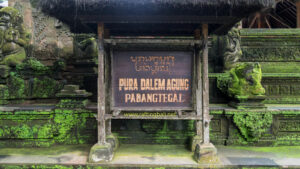
Pura Dalem Agung Padangtegal is a Balinese Hindu temple inside the Sacred Monkey Forest Sanctuary (Ubud Monkey Forest). It stands among dense forest and long-tailed macaques. So it easily catches your eye as you walk along the main path.
“Lebih nyaman membaca dalam Bahasa Indonesia? Buka panduan Pura Dalem Agung Padangtegal.”
If you are curious about the spiritual side of Ubud Monkey Forest, this guide explains what this main temple is, how local people use it, where to find it inside the sanctuary, and what it feels like to pause in front of the gate. So you know what you are looking at instead of just taking a quick photo.
Last updated: 28 November 2025 (WITA).
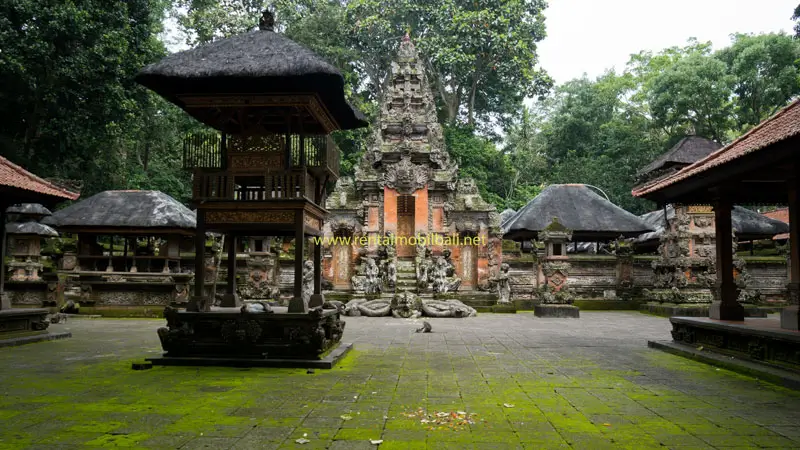
This page focuses on the temple’s meaning and on-site experience.
Opening hours, ticket systems, and visitor policies at Ubud Monkey Forest can change. So always reconfirm them on the official Sacred Monkey Forest Sanctuary website before you go.
Table of Contents[Hide][Show]
- Quick summary: key facts about Pura Dalem Agung
- Overview of Pura Dalem Agung Padangtegal
- Where Pura Dalem Agung sits inside Ubud Monkey Forest
- What the area around the temple feels like for visitors
- Temple zones and boundaries near Pura Dalem Agung
- How to notice Pura Dalem Agung during your visit
- Other Ubud places are often combined with this temple in one day
- Need help planning your Ubud route
Quick summary: key facts about Pura Dalem Agung
- What it is: One of three main temples in the Sacred Monkey Forest Sanctuary, dedicated to Lord Shiva in his Dalem aspect.
- Where you will see it: Along the main paved loop in the south-western area of the sanctuary.
- When you can see it: During Ubud Monkey Forest opening hours.
- Visitor access: Active village temple; worshippers use inner courtyards, visitors stay on the public path.
- Why it is worth a stop: Detailed carvings, mossy walls, offerings, and ceremonies show the forest’s spiritual side.
- Typical stop time: Most visitors spend around 5–15 minutes in front of the gate.
- Best for: Travelers interested in Balinese temple architecture and living Hindu culture, not just monkey photos.
Overview of Pura Dalem Agung Padangtegal
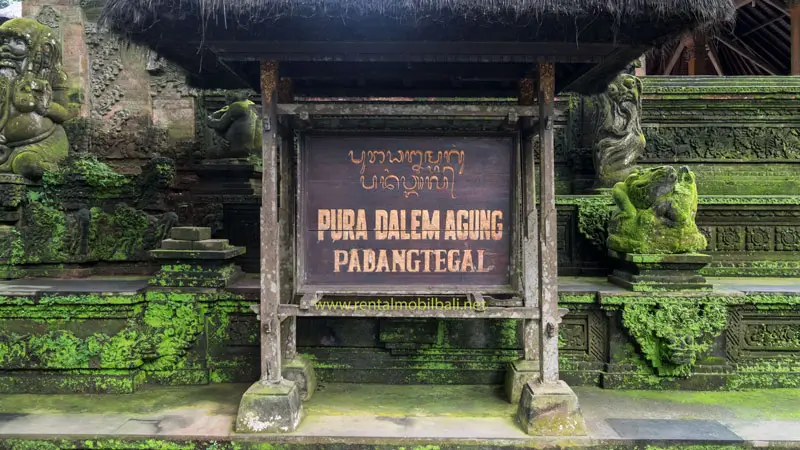
Pura Dalem Agung Padangtegal is one of the main temples of the traditional village of Padangtegal in Ubud. Balinese Hindus dedicate the temple to Lord Shiva in his Dalem aspect, linked with transformation, death, and the return of the soul. For local people, it connects daily life, ancestors, and the unseen world.
International visitors sometimes call it the “Padangtegal Great Temple of Death” because it plays a key role in death and renewal rituals. The phrase does not mean the temple is dark or frightening; it reflects the belief that death is one step in a longer journey.
“Pura Dalem Agung” is the formal name. Several temples in Bali share this name. Locals add “Padangtegal” to show that this one belongs to the Padangtegal community in Ubud and is spiritually linked with the village’s other temples.
The temple complex dates back to older kingdoms around Ubud. When you stand at the gate and look at the walls and shrines, you are seeing heritage that the same village has maintained and renewed over many generations.
Where Pura Dalem Agung sits inside Ubud Monkey Forest
Pura Dalem Agung is inside the Sacred Monkey Forest Sanctuary in Padangtegal Village. You cannot visit it from the street; you only reach the viewing area once you are already inside the sanctuary.
The temple stands in the south-western part of the forest, and maps and signboards usually mark it as “Main Temple” or “Dalem Temple.” If you follow the main paved loop, you will naturally pass the viewing area in front of its gate.
To make sure you do not miss it:
- Stay on the main paved paths, not every side track.
- Watch for signs to “Dalem Temple” or “Pura Dalem Agung”.
- Ask a staff member if you are unsure where to see the front of the temple.
These details help you know when to slow down and pay attention as you walk through Monkey Forest.
For the exact pin, you can open Pura Dalem Agung Padangtegal on Google Maps.
What the area around the temple feels like for visitors
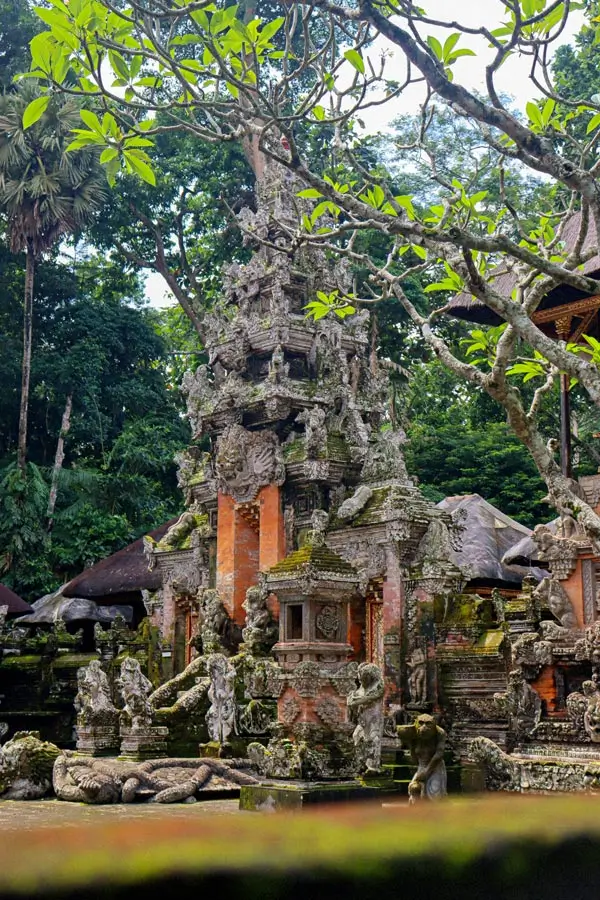
As you approach Pura Dalem Agung, you stay on the public path outside the most sacred inner zone. This part of Monkey Forest usually feels calmer and more solemn than the busier areas.
From the walkway, you can see:
- A traditional Balinese split gate (candi bentar) with detailed stone carvings.
- Temple walls and shrines are partly covered in moss against the bright green forest.
- Guardian statues and mythical figures near the courtyards.
- Daily offerings, such as canang sari, flowers, and incense, are made by local worshippers.
- Groups of long-tailed macaques move along the walls and trees.
If your visit coincides with a ceremony, you may see local people in traditional dress carrying offerings through the gate and hear chanting, bells, or gamelan from behind the walls.
Non-Hindu visitors mostly observe how this sacred space sits in the forest, how carvings and statues tell stories, and how the community still uses the temple.
Temple zones and boundaries near Pura Dalem Agung
From the outside, Pura Dalem Agung looks like one walled compound, but like many Balinese temples, it is divided into several courtyards with different levels of sacredness. You stand in the outer, public-facing zone, looking through the gate towards the inner areas.
A few details to notice:
- Low walls, closed gates, ropes, or changes in paving mark where the public path ends and temple space begins.
- Offerings and incense show that a spot is part of active worship, not just decoration.
- During ceremonies, the flow and direction of processions show how carefully the space is organized.
As a visitor, your role is to observe these boundaries, not cross them. This helps you read the space correctly and enjoy the view of the temple without entering areas meant only for worship.
How to notice Pura Dalem Agung during your visit
It is easy to walk through Monkey Forest and focus only on the macaques. If you want to notice Pura Dalem Agung, use this simple checklist:
- When you see signs for “Dalem Temple” or “Main Temple”, slow down instead of walking past.
- Pause in front of the gate and look closely at the carvings, guardian figures, and moss-covered walls.
- Pay attention to offerings, incense, or sound from inside; these show the temple is active, not just a backdrop.
- Notice how this calmer area feels different from the livelier parts of Monkey Forest.
You do not need a special route or extra time slot. The temple sits on the normal loop through Monkey Forest, so give yourself a few extra minutes to stand still and look with intention.
Other Ubud places are often combined with this temple in one day
Many travelers who visit Ubud Monkey Forest and Pura Dalem Agung also add these Ubud highlights to the same day:
- Tegalalang Rice Terrace: Terraced rice fields with layered green views and photo spots along the valley edge.
- Ubud Palace (Puri Saren Agung): The royal palace is in the town center, close to the traditional market and small shops.
- Blanco Renaissance Museum: An art museum with Antonio Blanco’s works and views over a lush river valley.
- Gunung Kawi Temple at Tampaksiring: An ancient rock-cut temple complex for visitors who enjoy history and can manage steps.
Combining Pura Dalem Agung with these stops gives you a one-day Ubud route that mixes culture, history, nature, and town life.
The information on this page is based on Wira Tour Bali field visits to Ubud Monkey Forest and on real visitor itineraries that include Pura Dalem Agung, reviewed up to the latest update.
Need help planning your Ubud route
If you want Monkey Forest, Pura Dalem Agung, and other Ubud stops to fit into one smooth day, ask the Wira Tour Bali team for help.
We can suggest:
- A simple order of stops that suits your hotel location.
- How long to stay in each place
- Transport options that match your group size and preferences.
 Taman Ayun Temple: Visitor Guide

We'd love to hear from you! Share your thoughts or experiences in the comments below!